


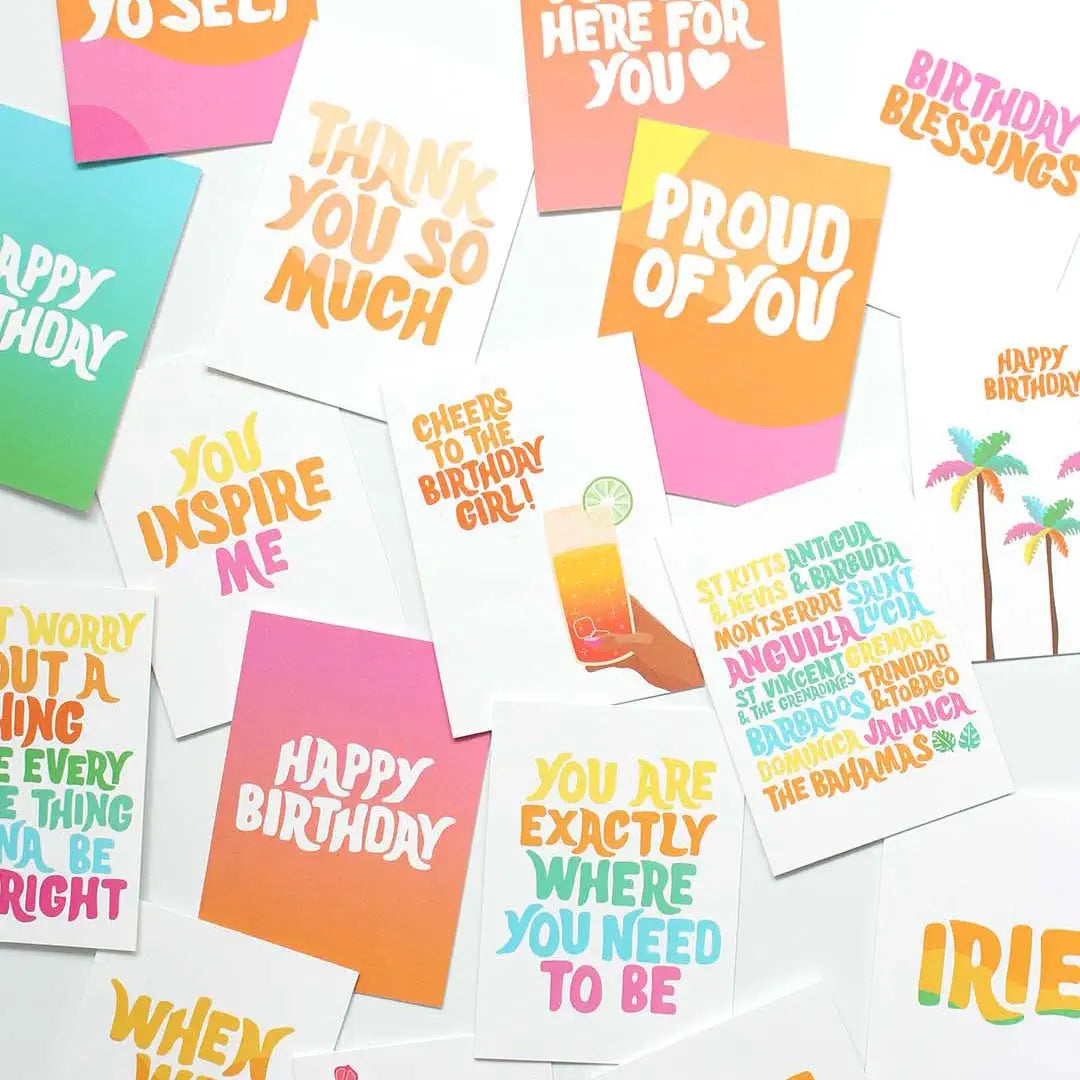
Buy 5 or more cards: get 10% off
Buy 10 or more cards: get 20% off
Buy 20 or more cards: get 30% off
No code needed, discount applied automatically at checkout ✨


Earlier this year, I took the Eurostar to Brussels for the opening of Postcolonial?, a new temporary exhibition at the House of European History (HoEH). The 'You Called We Came' bag from my graduate Windrush Collection is on display in the exhibition, alongside a custom 'Black & British' outfit featuring a denim jacket, jeans, and yellow top, made especially for the exhibition replicating the ‘Black & British’ motif from my Windrush Collection (now part of the permanent London Museum collection). Seeing my work in a museum outside the UK was so meaningful, and an amazing experience.
I wanted to write about it here on the blog, both to share the news and to share a sense of what the exhibition is about. It’s a well-researched, thoughtful, and interesting exhibition well worth visiting if you're in Brussels before March 2027.
Being educated in the UK, I was mostly taught about UK history and British colonialism, aside from reading Afropean: Notes from Black Europe by Johny Pitts in 2019 (a great read!). So it was interesting to get an insight into the colonial history of other European countries in this exhibition.
About the Postcolonial? Exhibition
Postcolonial? runs from 17 April 2026 to 14 March 2027 at the House of European History in Brussels. The exhibition explores Europe's colonial legacy, starting with the structural foundations of European colonialism, moving through how Europeans maintained power as their empires collapsed, and arriving at the present day. It asks the visitor: are we truly in a postcolonial era?
The exhibition brings together 195 historical objects and documents spanning from the 7th century to today, 25 contemporary artworks by artists engaging with decolonisation, and eight personal stories exploring how colonialism has shaped individual lives. It's presented in English, Dutch, German, and French, and entrance is free.

Image from House of European History
What the Postcolonial? Exhibition Covers
The exhibition is structured in four parts:
1. Structural foundations of European colonialism
The first part looks at the structural foundations of European colonialism and its long history from the 1400s up to 1945. It covers: what the defining features of colonialism were, and how recognising those systemic features makes it possible to identify them in the present day.
2. The End of Empire?
The second part, 'The End of Empire?', asks how Europeans preserved their power as their empires collapsed. In the aftermath of the Second World War, colonised peoples saw possibility for change, yet the reality was far more complicated.
3. Between independence and true freedom
The third section looks at the period between independence and true freedom. From the late 1950s, decolonisation gathered pace. In 1960 alone, 17 African colonies gained independence. But the euphoria was short-lived for many.
4. What now?
The fourth and final section, 'What now?', confronts the ways colonial history still shapes life today and looks at the artists, activists, researchers, and communities committed to change.
It's a thoughtful and at times challenging exhibition, but it's been put together with such care that makes it easier to digest all the information. I particularly enjoyed learning through the personal stories presented in the exhibition.
Why My Work is Included in the Postcolonial? Exhibition
My graduate Windrush Collection was created to honour the Windrush Generation, the Caribbean people who came to the UK from the late 1940s onwards as citizens of the British Empire, and who faced discrimination, institutional failure, and, for many, the devastating consequences of the Windrush scandal. My granddad came to the UK from St Lucia in the 1950s, and his story was a huge inspiration for my graduate collection, and everything I do today.

© European Parliament – House of European History, 2026.
The 'You Called We Came' bag and the 'Black & British' outfit are included in Postcolonial? as part of the story of Windrush and the lasting effects of British colonialism. The Windrush Generation's experience is a clear example of how colonial history did not end with independence but continues to shape the lives of people up to today.


I am honoured that the work I made for my university project can be used to help illustrate this story, especially internationally.
Visiting the Postcolonial? Exhibition at The House of European History
The House of European History is open seven days a week. Opening hours are:
| Monday | 13:00 - 18:00 |
| Tuesday to Friday | 09:00 - 18:00 (10:00 - 18:00 in July & August) |
| Saturday to Sunday | 10:00 - 18:00 |
Entrance is free, and no booking is required for groups of ten or fewer. The museum also has a permanent display that's also worth exploring on the same visit.

Image from Tihara Smith

© European Parliament – House of European History, 2026
Postcolonial? runs until 14 March 2027. If you're heading to Brussels, I'd recommend visiting.
About the House of European History
The House of European History is a museum in Brussels, Belgium, focusing on the recent history of the continent of Europe. It is an initiative by the European Parliament, and opened on 6 May 2017.
The museum collects, researches and exhibits memories, experiences and interpretations of European history, deepening knowledge and widening perspectives, encouraging the critical thinking and empathy needed to see historical events from other viewpoints.
The museum's mission is to help to build a more informed society aware of the consequences of European history for today and strengthened by the mutual understanding needed for a common future.
"Our current displays do not say enough about the ongoing impacts of colonialism. They neglect the voices of those who suffered and resisted colonial violence. This exhibition [Postcolonial?] marks the beginning of a journey for our team to address that shortcoming."
The museum's mission is to help to build a more informed society aware of the consequences of European history for today and strengthened by the mutual understanding needed for a common future.
Frequently Asked Questions
Where is the Postcolonial? exhibition and when does it run?
Postcolonial? is a temporary exhibition at the House of European History in Brussels, Belgium. It runs from 17 April 2026 to 14 March 2027. Entrance is free, and the museum is open seven days a week.
What is the Postcolonial? exhibition about?
The exhibition explores Europe's colonial legacy, from the structural foundations of colonialism in the 1400s through to the present day. It brings together historical objects, personal stories, and contemporary artworks to ask whether we are truly in a postcolonial era, and how colonial history continues to shape life today.
What work by Tihara Smith is on display at the House of European History?
Two pieces from Tihara Smith are included in the exhibition: the 'You Called We Came' bag from her graduate Windrush Collection, and a custom 'Black & British' outfit made especially for the exhibition. The work is featured as part of the exhibition's exploration of Windrush and the lasting effects of British colonialism.
What is the Windrush Collection?
The Windrush Collection is Tihara Smith's graduate fashion collection, created to honour the Windrush Generation, the Caribbean people who came to the UK from the late 1940s onwards as citizens of the British Empire. The collection uses raffia embroidery inspired by Caribbean craft traditions to tell that story through fashion and textiles. An outfit from the collection was acquired by the London Museum in 2021 and is now also represented internationally through the Postcolonial? exhibition in Brussels.
Sources and Further Reading
→ House of European History: Postcolonial?
→ Black & British: A Fashionable Windrush Story
→ Images: © European Parliament – House of European History, 2026
Related Posts


About Tihara Smith
Tihara is a fashion designer and textile artist passionate about design, the Caribbean and sharing the Windrush story. She loves creating distinctive pieces that allow people to have a little piece of the Caribbean 🌴✨